YECHENG APPAREL · MANUFACTURING GUIDE
Custom Clothing Manufacturing: A Complete Procurement Guide
Everything a brand buyer or product manager needs to understand the process -- from first contact through bulk delivery. Covering MOQ, timelines, Tech Packs, materials, QC, and choosing the right production route.
A Practical Resource for Apparel Buyers and Product Managers
Sourcing custom apparel from an OEM/ODM manufacturer involves decisions across materials, construction, decoration, branding, and logistics. This guide covers the full process in plain language -- so you arrive at each stage prepared.
YECHENG APPAREL has supported clothing brands in 47 countries since 2006. Our core production covers custom hoodies, T-shirts and tracksuits -- serving independent streetwear brands, private label clients, established fashion companies, and growing startups.
Complete Steps in Custom Apparel Manufacturing
From the first brief through bulk delivery -- here is every stage you should expect, and what happens at each one.
Project Inquiry & Requirements Review
Share your product type, design intent, estimated quantity, target market, and delivery expectations. The team reviews your Tech Pack, reference samples, images, sketches, or product concepts and identifies any gaps before proceeding.
Your input: brief, reference materials, quantity rangeProduct Specification Consolidation
Measurements, fabric composition, GSM, construction details, print or embroidery placement, trim and accessory specifications are confirmed in a structured document. This becomes the production reference.
Output: agreed spec sheetFabric & Material Selection
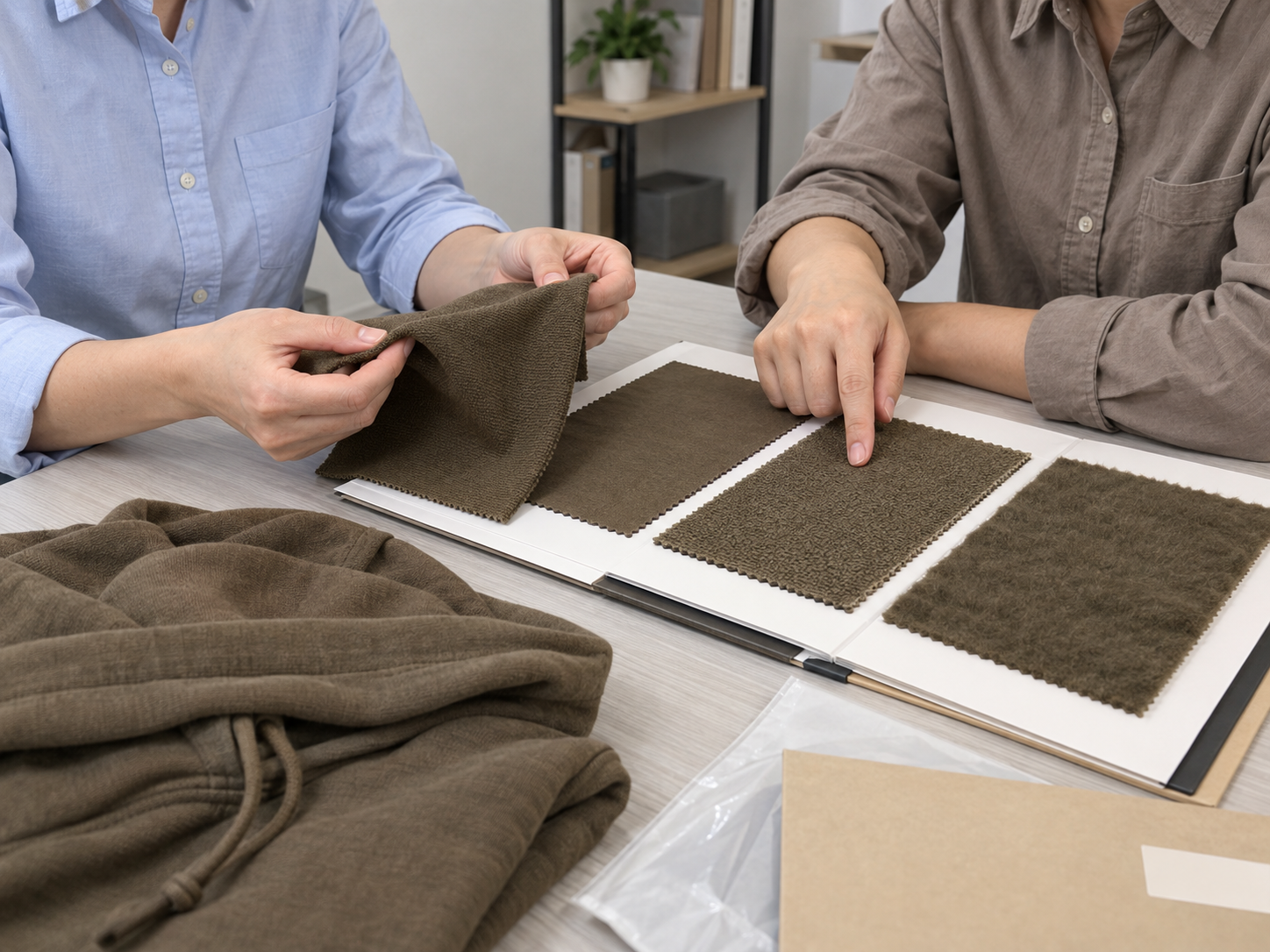
Sourcing fabric based on composition, weight, construction, finish, and decoration compatibility. You may receive swatch options for review before the sample begins.
Fabric, trims, zippers, drawcords, labelsPattern Making & Sample Development
The pattern is drafted, cut, and the first sample is sewn. Printing, embroidery, or wash effects are developed in parallel. The sample is photographed with measurements for your review.
Output: first sample with measurement reportSample Review & Revisions
You evaluate fit, fabric, construction, decorations, and branding details. Revision comments are addressed in subsequent sample rounds. Typically one to two rounds are required before approval.
1-2 revision rounds typicalPre-Production Sample Confirmation
A pre-production (PP) sample is made from bulk materials to confirm the final quality standard before the production run begins. This is the binding production reference.
Required: written approval before bulk startsBulk Production & Quality Checkpoints
Fabric and trims are checked on arrival. Cutting, sewing, decoration, washing or finishing, and packing proceed with in-line inspections. Measurements and workmanship are reviewed at key stages.
Inline QC at fabric, cutting, sewing, finishing, and packingFinal Inspection & Shipment
Finished garments are checked against the approved sample for appearance, measurements, labels, and packaging. Third-party inspection can be arranged before the order ships internationally.
Third-party inspection available on requestMOQ Factors & Project Evaluation
MOQ is not a fixed number -- it depends on product type, fabric, construction complexity, decoration method, and accessory sourcing. Here are the factors that shape the minimum viable order size for your project.
Fabric Type & Sourcing
Specialty or custom-dyed fabrics require minimum fabric purchase quantities. Standard stock fabrics allow more flexibility for smaller runs.
Print & Embroidery Method
Screen printing involves setup costs per color and works best at higher quantities. Embroidery digitization and DTF offer more flexibility for smaller initial orders.
Product Construction Complexity
Garments with more sewing operations, special finishes, or multi-layer constructions require longer per-unit time, which increases the effective minimum for an economical run.
Accessories & Hardware
Custom zippers, metal hardware, specialty drawcords, and branded trims typically have their own supplier minimums that may influence the order structure.
Label & Packaging Customization
Woven labels, custom hangtags, and branded poly bags have their own production minimums. Bundling these across multiple styles can help reduce per-unit cost.
Wash Effects & Post-Finishing
Garment dyeing, acid wash, enzyme wash, and distressed effects require batching minimums for consistent results across a production run.
Share your style count, color range, size breakdown, and decoration requirements in your initial brief. This allows the team to assess fabric and accessory minimums together and suggest the most practical order structure for your first run.
Sample Lead Time, Production Schedule & Shipping Timeline
Timelines are confirmed after reviewing your Tech Pack or reference material, decoration requirements, fabric availability, and order quantity. The figures below reflect typical ranges across common project types.
From confirmed spec to first sample with measurement report. Complex decoration or custom fabric adds time.
Per revision round. Most projects require one to two rounds before reaching pre-production sample stage.
After PP sample approval and material confirmation. Quantity, complexity, and peak season affect the schedule.
Sea freight to Europe or North America. Air freight is faster. Customs clearance time varies by destination.
Factors that affect delivery time
| Factor | Faster | Slower |
|---|---|---|
| Material availability | Stock fabric, standard trims | Custom-dyed fabric, specialty hardware |
| Design complexity | Standard construction, 1 decoration | Multi-process, complex washes, oversized hardware |
| Sample approval speed | Clear spec, prompt feedback | Multiple revision rounds, unclear references |
| Production season | Off-peak months | Pre-holiday peak periods |
| Shipping method | Air freight | Sea freight |
What You Need to Prepare Before Production
A full Tech Pack streamlines the sampling process and reduces revision rounds. If you do not have one, the team can work from reference materials -- but the more complete your brief, the faster and more accurate the first sample.
Complete Tech Pack Checklist
-
Technical Flat Sketches Front, back, and detail views with seam placement and construction notes
-
Measurement / Graded Size Chart POM measurements across all sizes in your size run
-
Fabric Specification Composition, GSM, construction (jersey, fleece, etc.), finish, and color references
-
Trim & Component Details Zipper type and color, drawcord material, eyelets, ribbing spec, hardware finish
-
Artwork & Placement Files Print or embroidery artwork in vector format, with position and size measurements
-
Label & Packaging Requirements Woven label art, care label content, hang tag spec, and individual packaging type
-
Color Standards Pantone or physical color standard references for fabric, print, and trim
What happens without a complete spec
Fabric, Decoration, Label & Packaging Decision Guide
Use this reference to understand your key product decisions before the project brief. Each choice affects cost, timeline, MOQ, and the final product experience.
Fiber, construction, and GSM work together -- evaluate them as a combination, not individually. The right choice depends on season, silhouette, and decoration method.
Choose a print method based on artwork type, color count, quantity, fabric, and the intended visual effect.
Embroidery adds durability and perceived value. Design complexity and stitch count determine cost and feasibility on different fabric weights.
Washed effects are developed on 100% cotton or cotton-dominant fabrics. Each effect requires batching minimums for consistent results across a production run.
Labels complete the brand presentation and communicate care, sizing, and origin. All label types can be developed in-house for private label orders.
Packaging protects garments during transit and enhances the unboxing experience. Options range from plain polybag to full branded retail packaging.
Quality Control & Inspection Process
Quality is checked against the confirmed sample and agreed specifications at every production stage -- not just at the end. Defects are identified, recorded, and resolved before advancing to the next phase.
Fabric & Material Inspection
- Color against approved standard (visual + spectrophotometer)
- GSM and fabric weight measurement
- Shrinkage and hand feel after wash test
- Color consistency across rolls and dye lots
- Trims: zipper function, drawcord strength, hardware finish
Cutting & Sewing Inspection
- Cut pieces checked against pattern and marker
- Stitch type, SPI (stitches per inch), and thread tension
- Seam alignment and construction accuracy
- Pocket, zipper, and detail placement
- In-line 100% check at critical sewing operations
Decoration & Finishing Inspection
- Print position, color accuracy, and registration
- Print adhesion and wash fastness test
- Embroidery thread color, stitch density, and backing
- Wash effect consistency and color uniformity
- Overall appearance against approved sample
Final Garment & Packing Inspection
- Measurement against approved size chart (per AQL)
- Workmanship: threads, puckering, clean finish
- Label content, placement, and attachment
- Hang tag, poly bag, and carton marking accuracy
- Third-party inspection by Intertek, SGS, or buyer's agent available
We support buyer-specified third-party inspections by Intertek, SGS, Bureau Veritas, or your own agent. Inspection can be arranged at pre-shipment stage or during production. Please advise in your order confirmation.
OEM, ODM & Private Label -- Which Route Is Right for You?
The three main production routes serve different project stages, brand structures, and levels of design ownership. Understanding the differences helps you choose the right approach -- and communicate it clearly in your brief.
OEM
Original Equipment Manufacturer
You provide a complete Tech Pack or fully defined specification. We manufacture exactly to your design. You own the design; we execute the production.
- Complete Tech Pack required
- Full production to your specification
- You control design, fit, and all details
- Pattern and sample made to your measurements
- Fabric and trims sourced to your brief
- Brand labels and packaging per your artwork
ODM
Original Design Manufacturer
You provide a direction -- reference images, sample garment, mood board, or design intent. We develop the pattern, spec, and construction. You review and approve through the sample process.
- Reference material or brief as starting point
- Pattern and spec developed by manufacturer
- Fabric, trim, and construction suggestions provided
- Sample-based approval before production
- Suitable for clients without in-house tech
- Brand labels and packaging applied on approval
Private Label
Branded Manufacturing
You select from an existing product base or develop a product for your brand. The focus is on applying your branding -- labels, hangtags, packaging -- to create a product line under your own brand identity.
- Brand-owned product with custom labeling
- Woven labels, care labels, hangtags, packaging
- Can be based on OEM or ODM production route
- Full brand presentation from garment to carton
- Suitable for DTC brands and wholesalers
- Supports exclusive colorways or design adaptations
Route Comparison at a Glance
| Consideration | OEM | ODM | Private Label |
|---|---|---|---|
| Design Ownership | Client | Developed jointly | Client brand applied |
| Starting Material | Complete Tech Pack | Reference / brief | Either route |
| Development Support | Execution only | Full development | Branding focus |
| Typical Client | Established brands | Growing brands | DTC & wholesale |
| Sample Rounds | 1-2 typical | 2-3 typical | 1-2 typical |
Frequently Asked Questions
Practical answers to questions buyers ask most often before and during the first project.
What is the minimum order quantity for custom hoodies, T-shirts, or tracksuits?
MOQ depends on fabric choice, product construction, decoration method, and accessory sourcing -- not a fixed number across all products. Some projects can start at lower quantities with stock fabrics and simpler construction; others with custom-dyed fabric and specialty hardware require larger minimums.
Share your product type, estimated quantity, color range, and decoration requirements in your inquiry. The team will assess feasibility and advise on the most practical order structure.
Do I need a complete Tech Pack to get started?
No. Projects can begin with a reference garment, product images, a design sketch, mood board, or a written brief describing the product intent. The more complete your starting material, the faster and more accurate the first sample will be -- but a full Tech Pack is not a prerequisite.
If you do not have a Tech Pack, the development team will help consolidate a production-ready specification based on what you provide, using the sample process to confirm details progressively.
How long does it take from inquiry to bulk delivery?
For a new project with sample development: the first sample typically takes 15-25 days, revision rounds 7-14 days each, bulk production 30-60 days after PP sample approval, and sea freight 20-35 days depending on destination. A new project from inquiry to door-to-door delivery is typically 4-5 months total.
For repeat orders with an approved sample: production can begin within 1-2 weeks of order placement, reducing total time significantly.
Can you develop wash effects like acid wash or garment dyeing?
Yes. We develop acid wash, enzyme wash, stone wash, garment dyeing, and distressed effects. These require 100% cotton or cotton-dominant fabrics and have batching minimums to achieve consistent results across a production run. Samples are developed to confirm the wash direction before bulk production begins.
Can you handle custom labels, hangtags, and packaging?
Yes. We manage woven labels, care labels, size labels, hang tags, polybag printing, tissue paper, stickers, and carton marking as part of the production process. Artwork files are reviewed during the development stage and confirmed before bulk production. Label and packaging options are available for all private label and branded OEM/ODM orders.
What quality control process do you follow during production?
Quality is checked at each stage of production -- fabric and material inspection on receipt, in-line inspection at cutting and sewing, decoration and finishing review, and a final pre-shipment inspection covering measurements, workmanship, labeling, and packaging against the approved sample.
Third-party inspection by Intertek, SGS, Bureau Veritas, or your own agent can be arranged at your request before shipment.
What decoration methods are available?
Available decoration methods include screen printing, DTF (direct-to-film), digital printing, heat transfer, foil, puff, and discharge printing; flat embroidery, 3D puff embroidery, chenille/towel embroidery, and appliqué. The right choice depends on artwork complexity, fabric type, color count, and order quantity. Samples are developed for each decoration method before production.
Can you support small trial orders before a larger production run?
Yes. We support sample development, small initial orders for market testing, and scaled bulk production. For new brands, a small pilot run helps validate fit, quality, and market response before committing to a larger quantity. Production minimums still apply based on fabric and accessory constraints, but the intent is to support long-term brand growth -- not to require large upfront commitments.
Project Inquiry Form
The more detail you provide, the faster we can prepare a structured cost and timeline estimate.