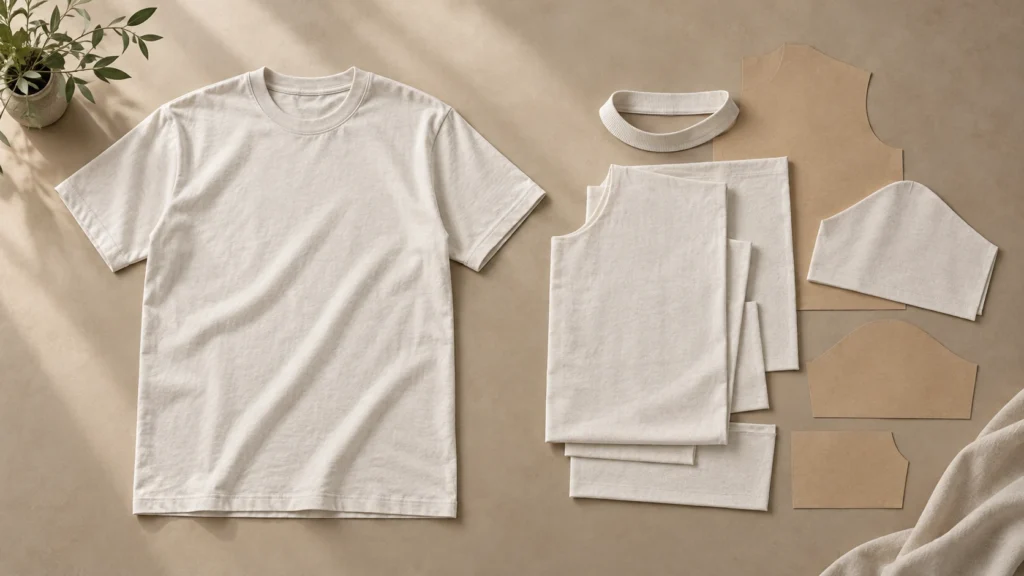
AI-generated concept illustration of a blank T-shirt alongside materials for custom garment production; not actual YECHENG production evidence.
For a first T-shirt collection, the useful question is whether an existing garment already delivers the product you want to sell. If its fit, fabric, neckline and seams work, decorating a blank may be enough. If the shirt’s shape or construction is central to the design and no available blank matches it, a custom pattern becomes a stronger candidate. Make that decision with samples and specifications before comparing quotes.
What are you actually choosing?
A blank is a finished, undecorated T-shirt made to an existing specification. You can select a stock style and add artwork or branding options that its supplier permits. In cut-and-sew OEM production, the manufacturer cuts fabric and assembles a shirt to a specification agreed for your project, which may use a new pattern or a revised existing block. The terms describe purchasing control, not two mutually exclusive sewing methods: many blanks were also cut and sewn. Men’s Tee Works explains this distinction.
There is also a middle route. A manufacturer may offer an established block that can be adjusted. Ask which measurements and details can change, what must remain fixed, and whether those changes require a new sample. Calling a shirt “custom” or “private label” does not establish how much control you have over its underlying pattern.
Start with a physical blank test
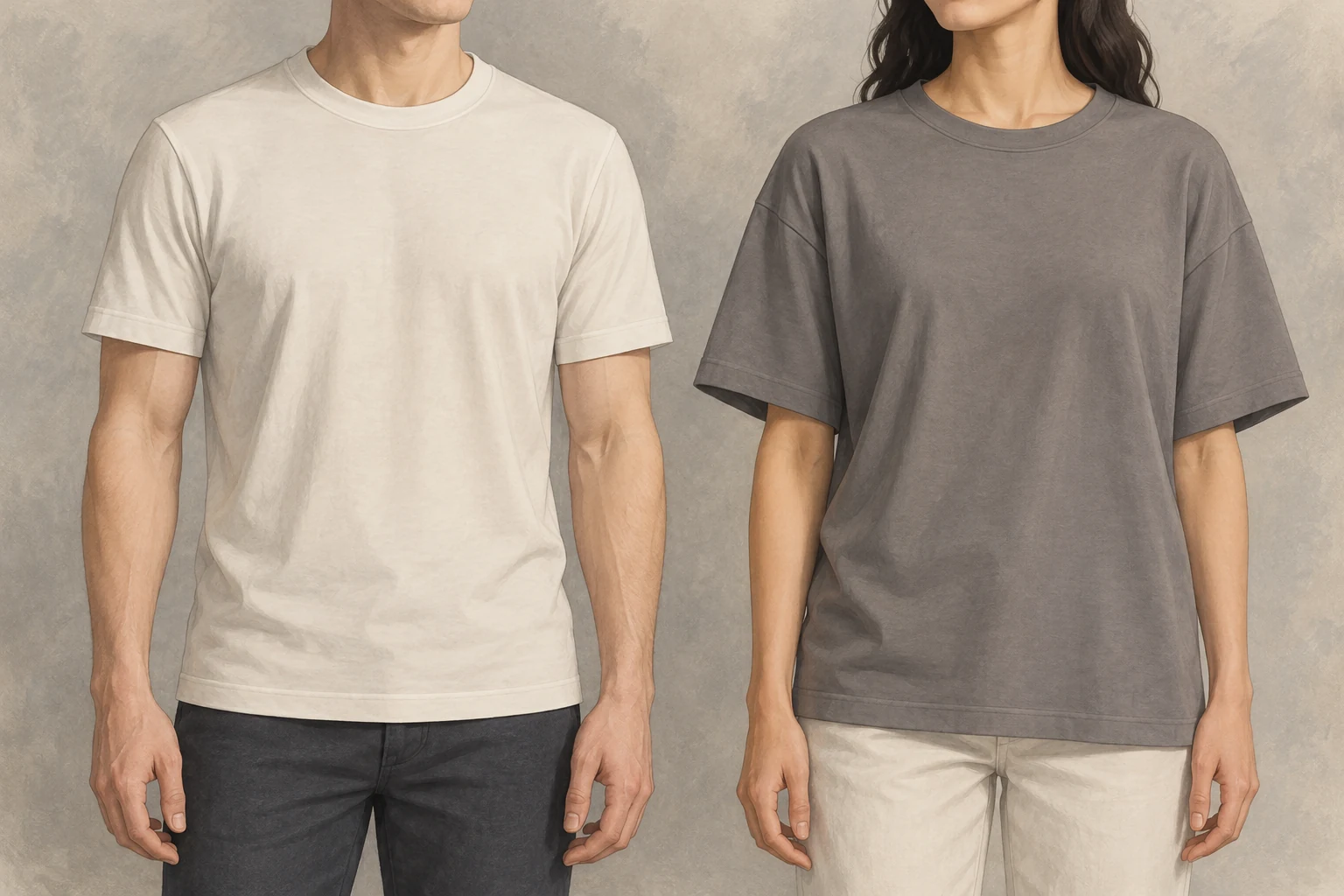
Choose one or two candidate blanks close to your intended silhouette. Obtain the exact style, fabric, color and sizes you might order. Compare each with a reference shirt that expresses your target fit. Measure chest width, body length, shoulder width, sleeve length and opening, and neck opening using the same method for every garment. Record how the shirt hangs on a fit model representing your customer. A flat measurement can match while the shoulder slope, sleeve shape or fabric drape still looks wrong. Techpacker’s fit-review guidance recommends comparing the sample, measurement specification and reference garment together.
Check the sample after care conditions relevant to your product. CottonWorks notes that dimensional change can affect garment fit and can be accompanied by issues such as seam puckering or twisting; it also cautions that shrinkage expectations need to reflect the actual material and process. That makes an after-wash comparison more useful than judging a fresh blank alone. CottonWorks’ shrinkage guide provides the technical background.
If a blank passes these checks, document its supplier, style code, color, size chart and approved sample. Ask about stock continuity and whether substitutions can be approved before use. A good first sample is less useful if the repeat order arrives in a different garment.
Identify changes that require a garment specification
A blank is a practical choice when your required changes are mainly decoration or permitted labeling and the existing body already works. A custom pattern is more relevant when you need a particular combination of chest width and body length, a different shoulder or sleeve shape, a distinct collar, altered seam placement or another construction detail unavailable in a stock style. A fabric target that available blanks do not meet can lead to the same decision. These are design requirements to test, rather than reasons to assume custom production is automatically better.
Write the requirements before approaching an OEM supplier. Specify the base size and measurement points, intended size range, fabric composition and construction, weight target if relevant, collar material, seams, hem finish, decoration placement and care expectations. Mark which details are essential and which are negotiable. Techpacker describes a tech pack as combining measurements, materials, construction notes, grading and revisions; its software examples show one way to organize those records, not a mandatory industry format. See Techpacker’s tech-pack guide.
If the artwork crosses seams or needs panel-level placement, discuss the decoration sequence as well as the garment pattern. For example, Printful describes an all-over-print workflow in which it prints fabric before cutting and sewing it. That is Printful’s process example, not a promise that every OEM factory or fabric will support the same result. Ask for a sample using your proposed artwork, fabric and construction.
Compare complete project costs, not just unit prices
A blank quote and an OEM quote may cover different work. Ask the blank supplier or decorator to separate the garment, decoration, labels, packing and freight. Ask the OEM supplier to identify pattern work, fabric sourcing, sampling, revisions, grading, production, decoration, inspection, packing and freight. Confirm whether the quoted quantity applies per style, color or fabric, and how any sample or setup charges are handled. The answers depend on the supplier and specification; there is no useful universal crossover quantity.
Also compare the risk you would carry. With a blank, the main questions may be availability, consistency between batches and the limits of decoration on a finished shirt. With OEM, you need to approve a pattern, materials and a finished sample before production. Allow room in the plan for review and possible revision, then request a project-specific schedule. Neither route should be chosen from an unverified delivery estimate.
A decision rule for the first collection
Use a blank if an obtainable style meets your essential fit and construction checks after relevant care testing, and its decoration and repeat-supply arrangements suit the collection. Move to a custom pattern or revised block if a defining requirement fails across the realistic blank options and the brand is ready to specify, sample and approve the replacement. If only one feature fails, ask whether an existing block can be adjusted before commissioning a wholly new pattern.
For either route, keep an approved physical sample and a written record of what it represents. For OEM, compare the production sample against the agreed measurements, materials and construction notes; record each revision and approve the final specification explicitly. This makes a repeat order easier to evaluate than an instruction such as “same as last time.”
What to send with your inquiry
A concise supplier brief can include:
- A reference shirt and photos showing the intended silhouette.
- Measurements for the base size, with clear measurement methods and the intended size range.
- Fabric composition, feel, weight direction and after-care priorities.
- Collar, seam, sleeve and hem details that must be retained or changed.
- Artwork files, placement and labeling requirements.
- Proposed quantity by style, color and size, plus the target delivery window.
- The specific question: can an existing blank or block meet these requirements, or is a custom pattern needed?
If you are evaluating custom production, the custom T-shirts page and request-a-quote page provide the relevant inquiry route. Share the brief and ask for the feasible production path, sample scope and a quote tied to your specifications.