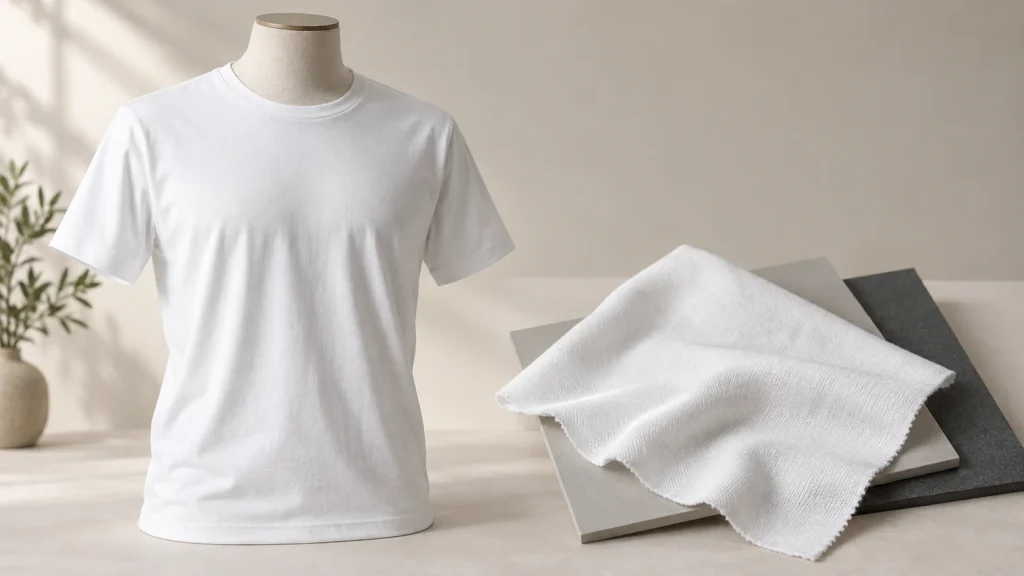
A white fabric swatch can look sufficiently covered when it lies on a table, then look different when it becomes a T-shirt. For a basics brand, the purchasing question is practical: will the finished shirt give the amount of coverage your collection promises, across the sizes and wearing conditions you intend to approve? Compare fabrics in a controlled way, then make the final decision on complete garments. Keep the reference sample and your acceptance notes together so a later production sample can be judged against the same target.
Define what “acceptable coverage” means for your brand
Start with a physical reference shirt that represents the look you want. Decide whether a faint outline beneath the shirt is acceptable, whether the result should be consistent across the front and back, and which underlayer colors matter to your intended styling. Write those decisions down before reviewing supplier samples. “Opaque white” by itself leaves too much room for different interpretations.
Record the exact white shade, intended fit and size range. If the collection includes a close-fitting version and a relaxed version, review each as its own garment. Decide which areas matter most: the chest, back, shoulder and hem may each appear differently in a worn sample. These are your brand’s visual acceptance points, rather than a universal textile pass mark.
Compare swatches under the same conditions
Ask for swatches representing each candidate fabric in the intended white shade and finish. Label them by supplier reference, composition, knit construction and stated weight. Place each swatch over the same dark and light backing, in the same position, under the same lighting. View it from a fixed distance, then repeat with the backing directly against the fabric. Photograph the setup only as a comparison record; camera exposure and screens should not become the sole basis for approval.
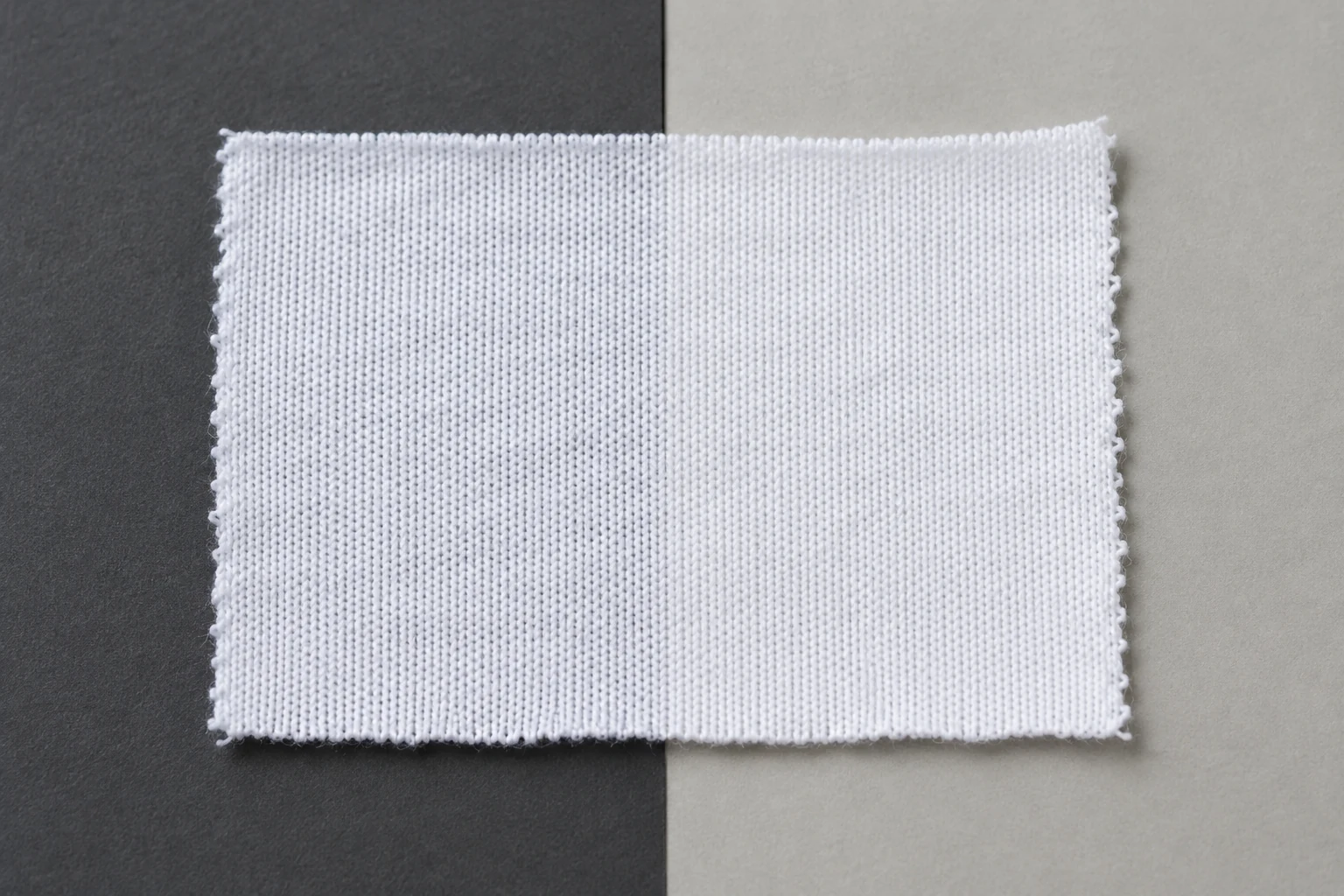
Compare both sides of each swatch. CottonWorks explains that single jersey has distinct technical face and back appearances, and that stitch length changes knit tension. Those are reasons to record the construction you actually sampled, rather than identifying a fabric only as “cotton jersey.” The CottonWorks page does not provide a white T-shirt opacity threshold. CottonWorks, Knit Basics
A fabric-weight figure is useful for matching a later submission to the fabric you reviewed, but it is not your coverage verdict. Keep any shortlisted swatch beside the finished sample and note what you could see through it in the agreed setup. If two swatches seem equally suitable, carry both into garment sampling instead of deciding from a small square alone.
Review the complete T-shirt on a fit model
Request complete samples in the proposed fabric, white shade, pattern and finish. A flat shirt can be checked for obvious variation, but the approval view should include the garment worn by a fit model representative of the intended customer. Use the same model, underlayer, lighting and viewing distance when comparing candidates. Check front, back and side views while standing normally, then review the movements relevant to the product brief, such as raising the arms or sitting.
Look at areas where the fabric sits close to the body and areas where it hangs freely. Record what is visible in each area rather than giving the whole shirt one vague score. If coverage differs between sizes or fits, state which version passed. A decision based on a relaxed sample should not automatically be extended to a closer-fitting pattern.
The point is to approve what a buyer can actually inspect on the proposed product. CottonWorks describes how knitted fabric loops allow flexibility and stretch; that background supports checking a worn garment, but it does not predict the appearance of any particular T-shirt. CottonWorks, Knit Basics
Use a lab result for the question it measures
If the purchase warrants an instrumented fabric comparison, ask the testing provider which method and sample setup they propose. AATCC TM148 is described by AATCC as a photodetector method for measuring the light-blocking properties of textiles and related materials. Its public page gives a purpose-and-scope summary, not a complete test procedure or an acceptance value for a shirt being worn. AATCC TM148
A report can help compare submitted fabrics when its method and conditions are clear. Keep the specimen identity and result with the garment review, and do not translate a light-blocking figure into a claim that the finished T-shirt will meet your visual target. The fit, backing and viewing setup in your sample review still need an explicit decision.
Make the decision traceable
For each candidate, record the swatch reference, composition, construction, weight, white shade, finish, garment pattern, sample size and date reviewed. Add short observations for the flat swatch and for each worn view. Use a simple decision such as “approve,” “revise” or “reject,” followed by the reason. For example: “Revise: back view shows more of the agreed dark underlayer than the approved reference.” That is more actionable than “too sheer.”
Before approval, review a sample after the care process you expect the product to carry. Compare it with the original under the same conditions and record any change you observe. If decoration is part of the style, use the decorated sample for the final review. An undecorated development shirt may help choose fabric, but it does not represent every aspect of the proposed saleable garment.
The approved physical shirt should match the written specification. If a supplier substitutes a fabric, changes the white shade or changes the finish, request a new comparison before treating it as equivalent. For related reading, see choosing T-shirt fabric and fabric weight.
White T-shirt coverage checklist
- Define the acceptable worn appearance with a physical reference shirt.
- State the intended white shade, fit, size range and relevant underlayers.
- Compare labeled swatches over identical light and dark backings.
- Record each candidate’s fabric identity and the exact setup used.
- Review complete garments on a representative fit model in consistent lighting.
- Check front, back, side and any movement views relevant to the brief.
- Record observations by area and size, with a clear approval decision.
- Recheck the proposed finished shirt after its intended care process.
- Keep the approved sample and specification linked to the final decision.
When asking for a custom T-shirt quotation, send the supplier your reference shirt, candidate fabric details, target fit and coverage observations. Ask for a sample plan tied to those requirements through the Request A Quote page. That gives both sides a concrete garment to evaluate before you approve the specification.