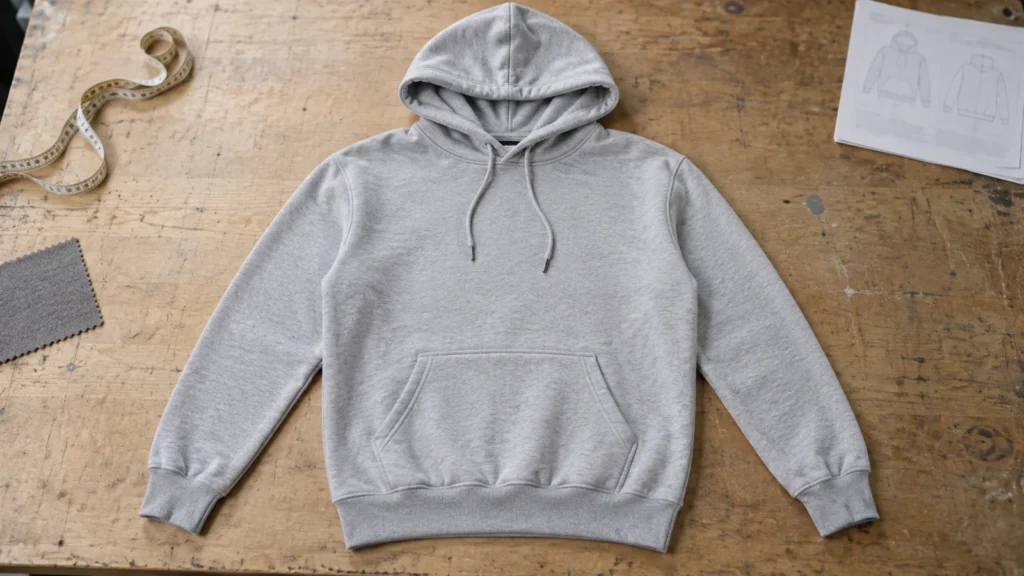
A hoodie looks simple, but its fit and function come from many parts working together. Body panels establish the shape; the hood, shoulders, sleeves, cuffs, and hem control how it sits and moves; and pockets, zippers, drawcords, seams, and labels add function and finish.
Not every hoodie includes every component. A pullover may have a continuous front and kangaroo pocket, while a zip-up needs a divided opening and may use split pockets. Drawcords, eyelets, hood linings, metal aglets, and cord locks are optional.
Understanding hoodie anatomy helps consumers describe products, designers prepare clearer tech packs, and brands review samples. The 18 parts below cover common structural and optional components across pullover, zip-up, streetwear, and performance hoodies.
18 Typical Parts of a Hoodie
1. Front Body Panel
The front body panel forms the main front section of the hoodie. It helps establish chest width, body length, hem width, pocket placement, and the available area for front graphics or embroidery. On a pullover, the front may be one continuous section, although pockets, seams, or design panels can change the pattern layout.
A full-zip hoodie requires a center-front opening, so the zipper and its seam allowances divide the front construction. The two sides must remain balanced through cutting and sewing. If the front panels, pocket edges, zipper, or hem do not align, the finished garment can look twisted even when the basic measurements are correct.
2. Back Body Panel
The back body panel controls back width, back length, and the relationship between the shoulders and hem. It also helps balance the front of the garment. A back that is too narrow can restrict movement or pull the side seams backward, while excessive width can change the intended silhouette.
Brands often use this area for back printing or embroidery, but decoration must account for any yoke, center-back seam, or panel line. Artwork placement should follow the approved pattern rather than a generic hoodie diagram.
3. Hood
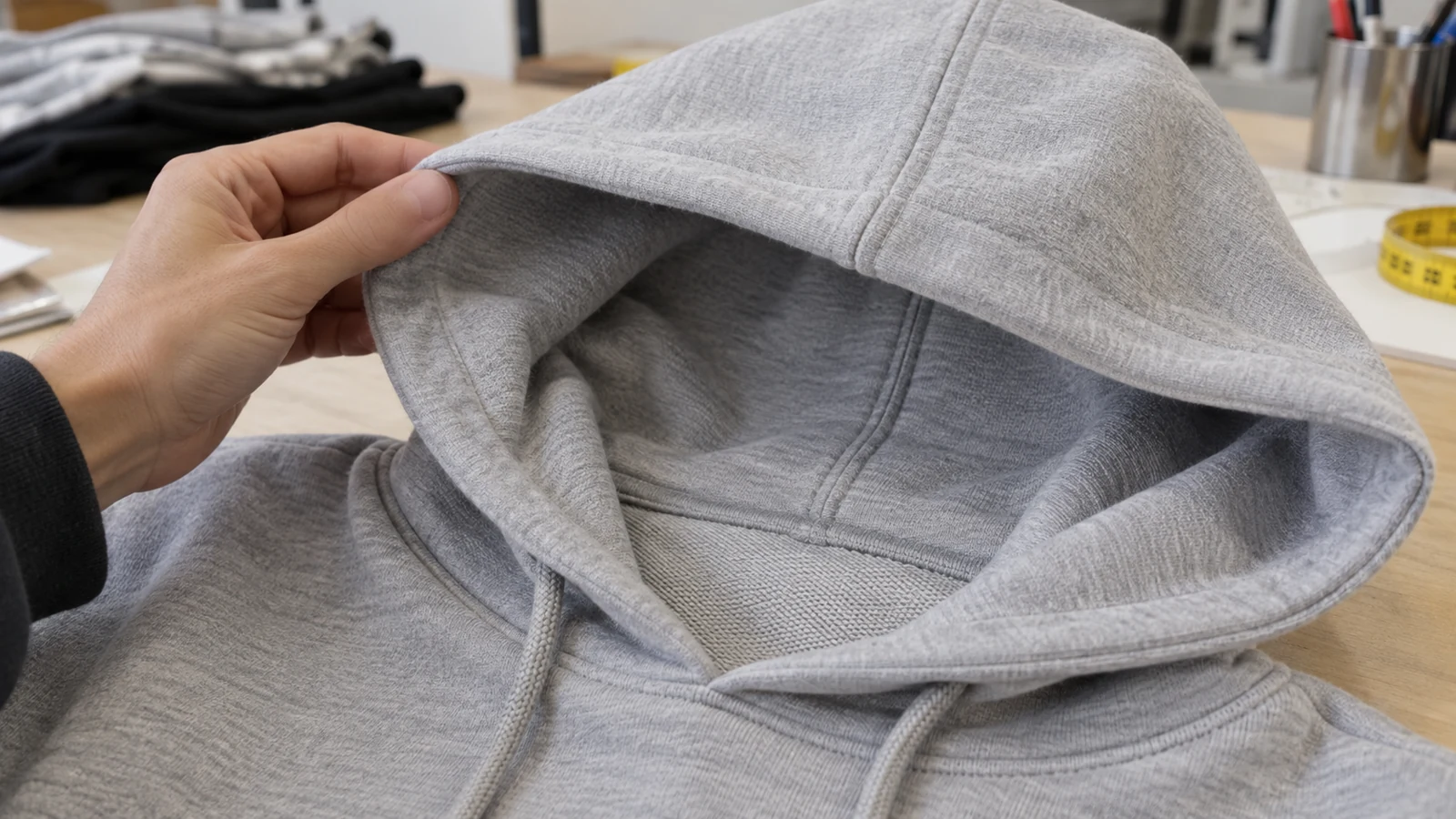
The hood is the component that defines a hooded sweatshirt, yet its construction varies widely. A hood may be single-layer, double-layer, self-fabric lined, or made with a separate lining. It can use two panels, three panels, or another arrangement chosen for shape and appearance.
Hood depth, height, face opening, neck opening, and overall volume determine how it frames the head and rests on the back. A small hood can feel tight and pull at the neckline. An oversized hood can add visual weight and affect garment balance. Hood dimensions therefore need to be developed together with the neckline, shoulder shape, and fabric structure.
4. Hood Lining or Inner Layer
Not every hood has a separate lining. Some hoodies use a single layer of body fabric, some use two layers of the same fabric, and others add a contrast or specialized inner material. A self-fabric double layer should not automatically be described as a separate lining if the construction does not use one.
The inner layer can create a cleaner interior, hide seam allowances, add structure, and change weight, drape, and comfort. Because two layers behave differently from one, seam bulk, the drawcord channel, and body attachment should be reviewed on the sample.
5. Neck Opening and Hood Seam
The neck opening is where the hood and body meet. Its shape affects pull-over ease, front-neck comfort, and the position of the hood when it is down. On a zip-up, the neckline must also meet the top of the zipper cleanly. A poorly balanced opening can make the hood pull backward or create excess fabric at the front.
The hood attachment seam joins the hood to the front and back necklines. Coats explains seams as joins where layers of material are held together with stitches, and it classifies several construction types. The suitable seam and stitch depend on fabric, stretch, bulk, appearance, and the intended finish; there is no single mandatory hood seam for every hoodie.
6. Drawcord or Drawstring
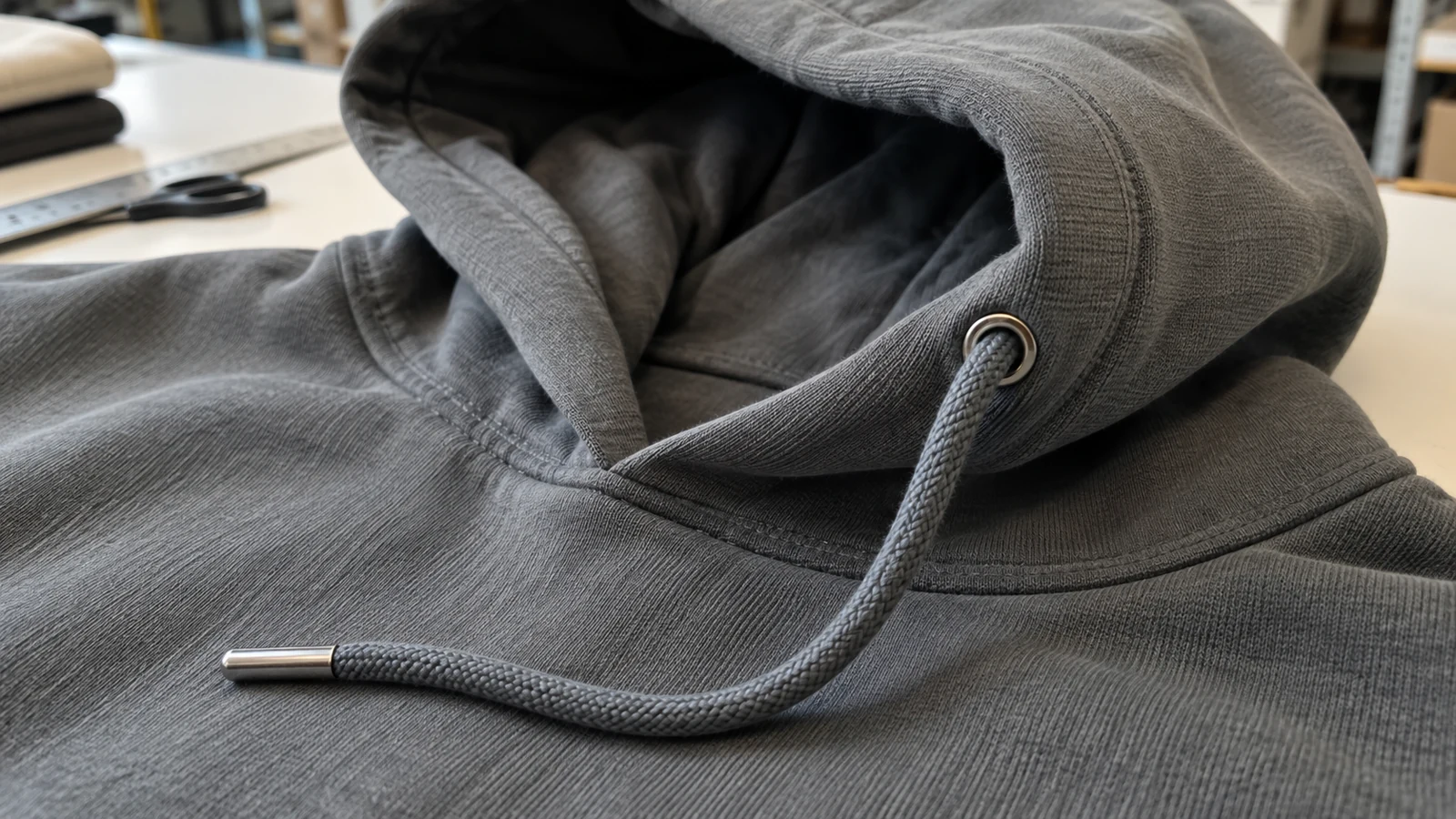
A drawcord adjusts the hood opening or serves as a visible design detail. It may be round, flat, braided, or made with another construction, and its thickness and hand should suit the hood channel and hardware. Some hoodie designs deliberately omit the drawcord, especially when a cleaner face opening or a specific market requirement is preferred.
The cord itself is different from the components around it. An eyelet forms a reinforced exit through the hood, while an aglet or cord end finishes the free end. A cord lock sits along the cord to hold its position. The guide to drawstring hardware terminology explains those distinctions in more detail.
7. Eyelets or Grommets
Eyelets or grommets are commonly installed where a hood drawcord exits the fabric. They support the opening and create a finished edge, but they are not required when a hoodie has no drawcord or uses a sewn opening instead. Metal is common, yet the material, shape, and attachment system can vary.
YKK lists an eyelet as a possible drawcord port and notes that attachment quality depends on the fabric and equipment. In hoodie development, the eyelet, washer, reinforcement, hood thickness, and hole placement must work as one system. A secure component on one fabric may need a different setup on another.
8. Cord Ends or Aglets
Cord ends, often called aglets, fit over or attach to the free ends of a drawcord. They can help control fraying, make the cord easier to handle, and add a finished visual detail. Metal, plastic, molded, folded, and other constructions are available, so the term describes a functional position more than one universal design.
Cord ends are optional trims, not proof of overall hoodie quality. Their finish, weight, dimensions, attachment, and compatibility with the cord matter more than the presence of metal alone. During sampling, brands should check that the ends are secure, smooth, aligned, and suitable for the garment’s intended care rather than specifying only “premium aglet.”
9. Shoulder Construction
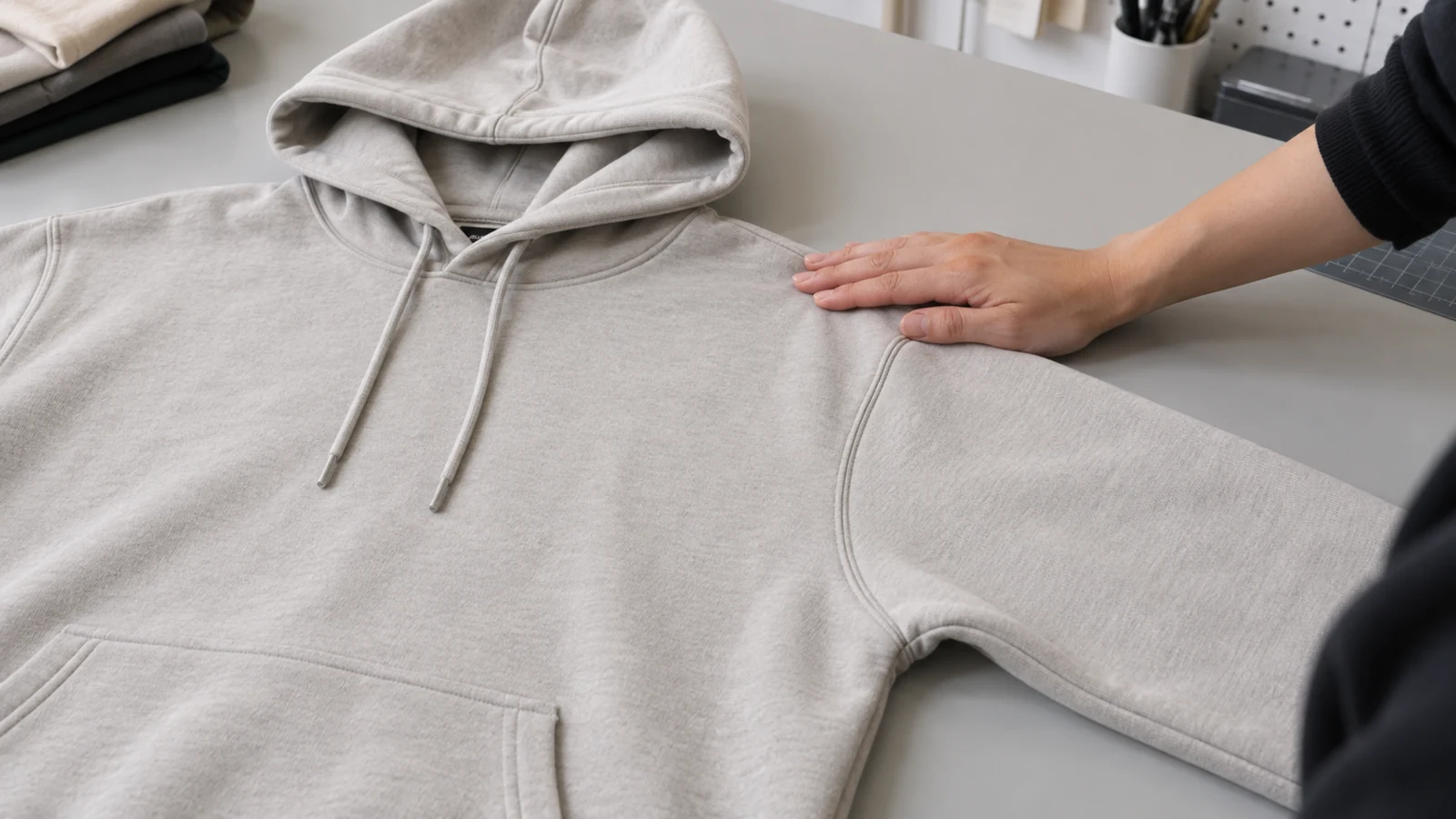
The shoulder is a construction zone rather than an accessory, but it strongly defines hoodie anatomy. Set-in sleeves create a recognizable shoulder seam around the armhole. Dropped shoulders move that seam farther down the upper arm, while raglan construction uses a diagonal seam toward the neckline. Other panel arrangements are also possible.
Shoulder position changes the perceived width, sleeve hang, mobility, and overall silhouette. An oversized hoodie should normally use coordinated pattern proportions instead of relying only on a larger size. The discussion of modern oversized hoodie proportions provides more context, but the correct construction still depends on the brand’s intended fit.
10. Sleeves
Sleeves control arm volume, sleeve length, movement, and the transition into the cuff. A streetwear hoodie may use a fuller sleeve for volume, while a performance-oriented design may use a more controlled shape. Neither direction is automatically better; it must match the body, shoulder, and use case.
The sleeve pattern cannot be evaluated in isolation. Its cap or upper shape must coordinate with the armhole and shoulder construction, while the lower opening must feed naturally into the cuff. Excessive length, twisting, or uneven fullness often becomes visible only on a sewn sample. Brands should therefore review sleeve hang from front, side, and back views.
11. Armhole
The armhole is the opening and construction zone where the sleeve joins the body. It affects mobility, underarm comfort, sleeve pitch, and the apparent width of the torso. A regular set-in hoodie and an oversized dropped-shoulder hoodie can use very different armhole shapes even when their chest measurements appear similar.
If the armhole is too tight, movement can pull the body upward. If it is too deep or poorly balanced, excess fabric may collapse under the arm or change sleeve direction. The solution is not one fixed measurement. The armhole, shoulder, chest width, sleeve volume, fabric stretch, and intended ease need to be assessed together.
12. Cuffs
Hoodie sleeves commonly finish with rib-knit cuffs, although the exact rib construction, fiber content, width, and tightness vary. The cuff controls the wrist opening, completes the sleeve edge, and helps manage sleeve fullness. Its recovery also influences whether the opening returns to shape after wear.
A cuff that is too tight can feel restrictive and create excessive gathering above the wrist. A loose cuff may not support the intended sleeve shape. Common options include different rib structures, but no single 1×1 or 2×2 construction is mandatory. The rib’s stretch, recovery, weight, and color should be reviewed with the main fabric and approved fit.
13. Hem or Waistband Rib
The bottom of a hoodie often uses a rib band described as hem rib, bottom rib, or a waistband. Industry wording varies, and some designs use a self-fabric hem or another finish instead. This component finishes the lower edge and influences the opening, body shape, and how the garment sits at the hip or waist.
A tight band pulls the body inward and can create a blouson effect. A relaxed or wide band can support a straighter, boxier silhouette, while cropped proportions require their own balance. The bottom rib should coordinate with body width, length, fabric weight, and side-seam alignment rather than being copied from an unrelated style.
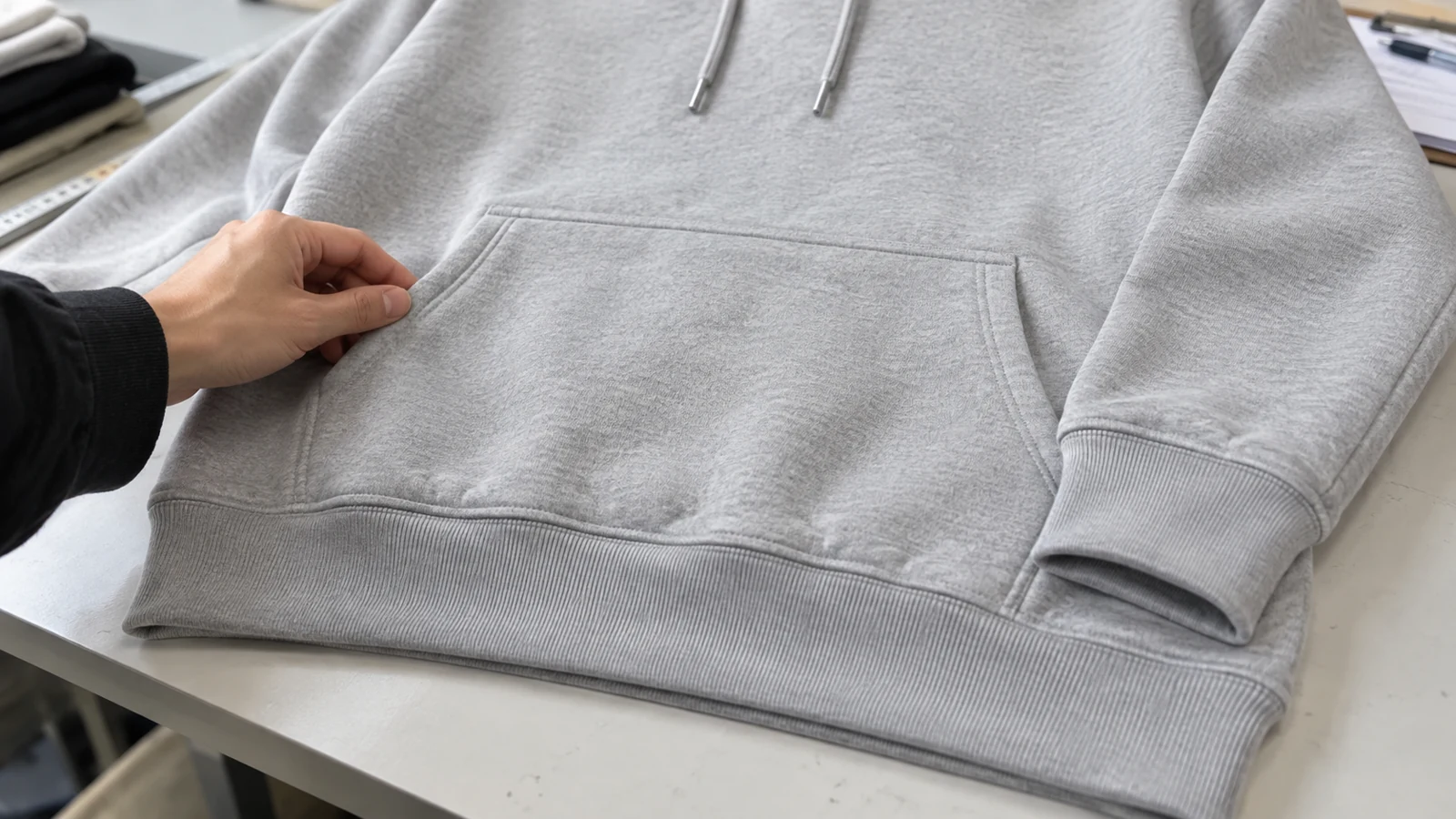
14. Kangaroo Pocket
The kangaroo pocket is a classic pullover-hoodie feature. It is usually a front patch-style pocket with access from both sides, but not every pullover includes one. Pocket width, height, opening angle, placement, reinforcement, and topstitching all affect usability and appearance.
Its position also competes with front graphics, embroidery, and seams. A pocket placed too high can crowd the chest; one placed too low may interfere with the hem. The openings need enough support for repeated use without becoming bulky. During sample review, check symmetry, hand access, stitching, and whether the pocket lies flat on the body fabric.
15. Welt Pockets or Split Front Pockets
A full-zip hoodie cannot use one uninterrupted kangaroo pocket across the center front. Designers may instead use split kangaroo pockets, welt pockets, side-entry pockets, zip pockets, or another solution. These options create different visual lines and levels of security; no one construction is required for every zip-up.
Pocket choice affects front-panel patterning, zipper clearance, seam bulk, and hem alignment. Split pockets should appear balanced on both sides of the zipper. Welt and zip pockets need accurate openings and reinforcement. Brands should define the pocket type and dimensions in the tech pack rather than using “front pocket” as a complete instruction.
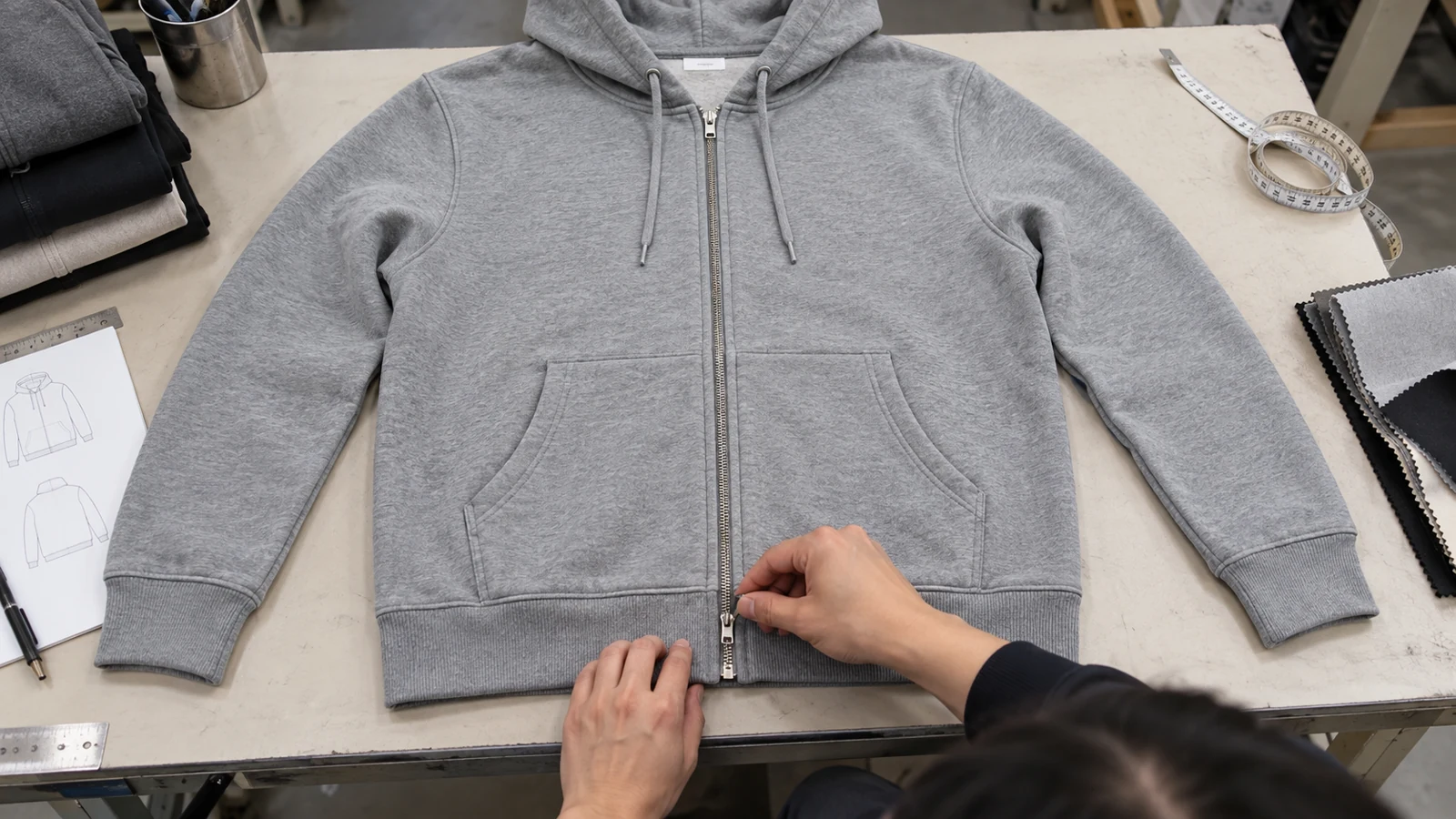
16. Zipper and Zipper Components
Zippers apply to zip-up hoodies, not to every hoodie. A zipper system can include tape, interlocking elements or teeth, a slider, puller, top stops, and lower closed-end or open-end components. YKK’s official zipper basics distinguishes metal, coil, and molded-plastic types, while ASTM D2050-23 provides current terminology for textile fastener subassemblies.
For a hoodie, zipper length, tape behavior, slider operation, center-front alignment, and the meeting point at the hem must be confirmed during sampling. A recognized supplier name does not replace a product specification, and the appropriate type depends on fabric, design, use, and required finish.
17. Seams, Stitching, and Topstitching
Seams join the hoodie components; stitches create or finish those joins. Typical inspection areas include shoulders, armholes, side seams, hood seams, pocket edges, cuffs, and the bottom band. Topstitching may secure seam allowances, control edges, or provide a visible design line.
The Coats sweatshirt application guide shows overlock, coverseam, and bartack references for sweatshirt production. ISO 4916:1991 classifies and designates stitched seam types, while ASTM D123-23 compiles textile terminology. These references support consistent technical language, but they do not require every hoodie to use an identical stitch configuration.
18. Labels and Internal Branding
Internal components can include a brand or main label, size label, care label, and information about fiber content, origin, or the responsible business. A hang tag is an additional merchandising item, not part of the sewn garment structure in the same way as an internal label.
For the US market, the FTC’s apparel-labeling guidance explains that most textile products need fiber content, country of origin, and responsible-business identification. The Care Labeling Rule covers regular care instructions. ISO 3758:2023 provides international care-symbol context, but US compliance must still be assessed under applicable US rules.
Which Hoodie Parts Change Between Pullover and Zip-Up Styles?
Pullover and zip-up hoodies share the same basic garment systems, but the front construction changes their component relationships. A pullover commonly uses a continuous front body and may include a one-piece kangaroo pocket. It has no full center-front zipper, so the neckline and hood opening can be developed without accommodating an open-end closure.
A zip-up divides the front and adds zipper tape, elements, a slider, stops, and an open-end system. That opening changes pocket options: the design may use two split pocket sections, welt pockets, side-entry pockets, or zippers. The center front must remain straight, and the pocket, rib hem, hood edges, and any front artwork must align across both sides.
The hood, sleeves, armholes, cuffs, bottom finish, seams, and labels follow the same broad logic in both styles. Their patterns may differ because the front opening changes balance and assembly; a pullover pattern should not simply be cut down the middle.
Which Hoodie Parts Affect Fit the Most?
Body width and length create the basic silhouette, but the shoulder, armhole, sleeve, hem opening, and hood volume determine how that silhouette behaves. A wider chest alone does not guarantee a convincing relaxed fit. If the shoulders remain narrow, the sleeve cap stays high, or the hem is too tight, the garment may look like the wrong size rather than an intentional oversized design.
Shoulder position sets the visual frame. The armhole and sleeve control movement and upper-body volume. Body length affects whether the hoodie feels cropped, regular, or long, while the rib opening changes how the lower body hangs. Hood volume adds weight around the neck and upper back, so it must match the body and fabric.
For brands developing custom hoodies, these parts should be approved as a coordinated pattern. Measurements remain important, but a fit session should also assess balance, mobility, drape, and the relationship between components.
Which Parts Should Be Defined in a Hoodie Tech Pack?
A useful hoodie tech pack should identify the components that affect patterning, assembly, trim purchasing, and quality review. It should define the hood construction, neckline, shoulder type, sleeve and armhole direction, pocket style, cuff, bottom finish, and zipper when applicable. Drawcords, eyelets, cord ends, labels, decoration locations, and critical measurements also need clear references.
The document should remove ambiguity for the specific style. Support component names with measurements, materials, finishes, placement, construction notes, and an approved sample where appropriate. “Standard hood,” “normal pocket,” or “metal tip” is rarely precise enough.
The guide on how to customize a hoodie covers the wider development sequence. Within an OEM/ODM apparel development process, the tech pack and sample should be reviewed together because a change to the hood, zipper, pocket, or rib can affect other measurements and assembly steps.
The Simple Way to Understand Hoodie Anatomy
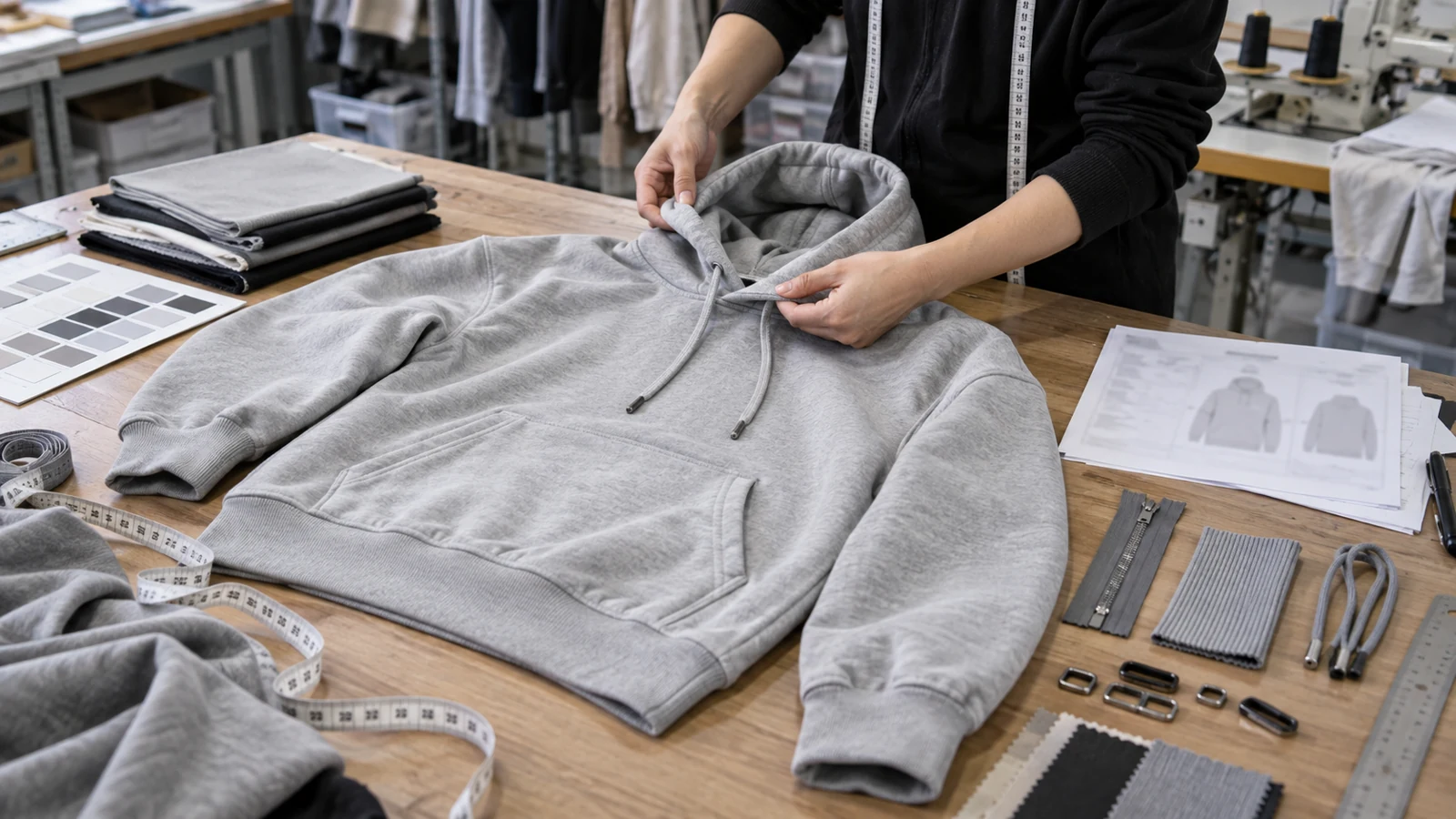
Hoodie anatomy is easier to understand as connected systems. Bodies, shoulders, sleeves, and armholes form the structure. The hood, neckline, drawcord, eyelets, and cord ends form the hood system. Cuffs, rib, pockets, zippers, and seams finish openings and connect components. Labels provide branding, sizing, care, and other product information.
Not every style uses every item. Pullover and zip-up hoodies solve the front opening and pocket area differently, while drawcords, aglets, linings, and certain hardware may be optional. What matters is not the number of features but how the selected components work together.
A well-developed hoodie depends on proportion, material, attachment, and construction across the whole garment. Strong fabric cannot correct a poorly balanced hood, and premium hardware cannot compensate for weak alignment. The complete sample shows how the parts interact.
Developing a Custom Hoodie?
For custom hoodie development, the hood, body, sleeves, pockets, rib, zipper, and trim details should be confirmed together during sampling because changing one component can affect the balance of the entire garment. If you are preparing a hoodie specification or reviewing a sample, contact YECHENG APPAREL to discuss the construction requirements for your project.